Bring Clarity Principles Into Your Organization
The ideas behind Clarity Principles can enter an organization in different ways. Put the book into the hands of your leadership team. Bring Mike in for a keynote or leadership event. Or start directly with a Leadership Clarity Session built around your organization. Each creates a different opportunity for leaders to develop a common lens for seeing what may have become normal.
There is no required starting point.
Put Clarity Principles into the hands of your leadership team, and use the ideas to create shared language and conversation around what they’re seeing inside the organization.
Bring Mike directly into the room, as a keynote or leadership event, to challenge familiar assumptions and create a shared conversation among leaders. No prior familiarity with the book is necessary.
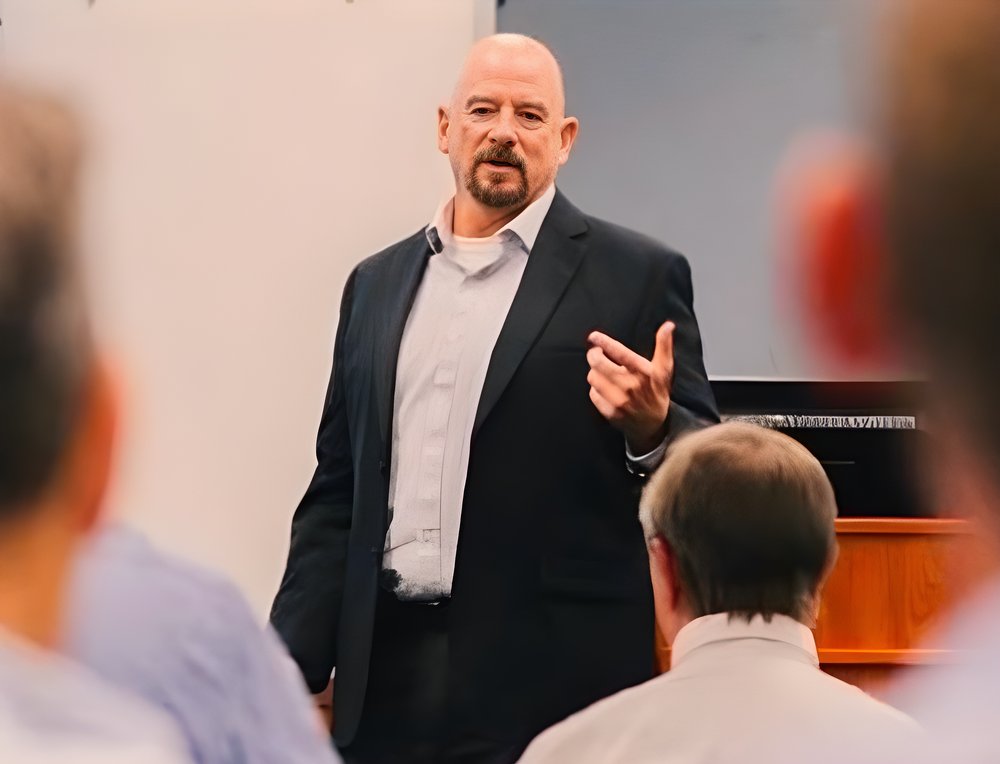
Start directly with a Leadership Clarity Session, built around the organization itself. Mike works with the leadership team to examine what has become normal, where friction or dependency may be hiding, and what those conditions may be costing the business.
However the thinking enters the organization, the value isn’t simply in reading or hearing the ideas. It’s what happens when leaders begin applying them to their own organization.
A leadership team begins to see through a common lens.
Different leaders are often looking at the same organization from different seats. Operations sees a workflow problem. Finance sees a capacity problem. Someone else sees it as a leadership problem. Often, they’re looking at different symptoms of the same underlying condition without realizing it.
Clarity Principles gives leaders a common way to recognize those patterns and look beneath the symptoms together. Once they can name what they’re seeing, they can begin to see what it has been costing them.
The conversation moves from the principles to the organization.
Once leaders begin looking through a common lens, the conversation changes. Instead of asking why one department keeps running into the same problem, they start asking what is happening in the organization that keeps producing it.
Where have we let friction become normal?
What aren’t we seeing anymore because we’ve stopped looking for it?
Where are capable people compensating for something that shouldn’t require compensation?
Those aren’t questions a book can answer for an organization.
Patterns that had become normal.
What starts to surface are constraints nobody had named out loud, assumptions that had gone unquestioned for years, and dependencies on one or two people that the rest of the organization had simply learned to work around.
Those patterns aren’t simply frustrating. They have a business cost.
- Leadership capacity gets consumed.
- Decisions slow.
- Dependency deepens.
- Morale erodes.
- Growth gets harder.
- Cost increases.
The goal isn’t simply to solve what you can see today.
Addressing the friction, dependency, or constraint in front of you matters. But the larger opportunity is helping leaders develop the perspective to recognize how those conditions form in the first place.
Left unchecked, these conditions rarely stay contained. They consume capacity, affect people, and eventually show up in the performance of the business.
Organizations build infrastructure around the things they cannot afford to leave to chance.
Finance has it. Technology has it. Operations has it. Leadership often doesn’t.
When leaders across an organization develop a common way of seeing the business and catching patterns early, leadership starts to function differently. It becomes part of how the organization sees, anticipates, and responds, rather than something left to whichever leader happens to notice a problem first.
Curious what this could look like inside your organization?
Start with a conversation about what your leaders are seeing, what may have become normal, and what it may already be costing your organization.