The Moment Growth Gets Expensive
As organizations grow, there comes a point where progress starts requiring noticeably more effort than it used to. Revenue may still be increasing, customers are still being served, and the business continues moving forward, but something feels different.
Growth has become heavier.
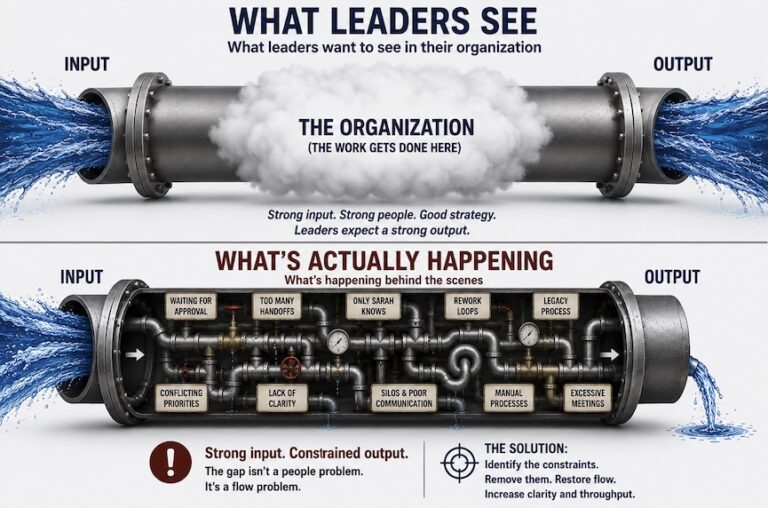
It rarely happens because of one major problem. Often it’s the result of small layers of complexity accumulating over time. An extra approval gets added. A process begins depending on one individual. Meetings multiply. Leaders stay involved in decisions they should no longer need to make. People create workarounds because they’re easier than fixing the underlying issue.
None of those decisions seems significant on its own.
Together, they quietly change how the organization operates.
The mistake many leadership teams make is assuming this heavier feeling is simply the price of becoming a larger company.
It isn’t.
Growth should create more capability, not require exponentially more effort.
When every new customer, employee, or initiative adds more management overhead than organizational capacity, the business begins paying an invisible tax on its own success.
That’s the moment growth becomes expensive.
What’s interesting is that organizations often respond by hiring more people, adding another manager, or implementing another tool. Sometimes those are the right decisions. But if the underlying friction remains, the additional investment often gets absorbed by the very system that’s creating the drag.
The issue isn’t that people aren’t working hard enough.
It’s that the organization has gradually become heavier than it needs to be due to all the hidden constraints that now exist.
One of the healthiest questions a leadership team can ask is, “Where has growth in an area become more complex without adding capability?”
The answers to that question often reveal opportunities to remove friction, clarify ownership, and restore capacity that the organization already possesses.
If growth feels more exhausting today than it did a few years ago, it may be worth exploring whether the business has become more complex than it has become capable.