The Hidden Constraints Leaders Don’t See
Most organizations don’t struggle because they lack talented people.
More often, they’re struggling because the flow of work has silently become constrained over time.
It rarely happens because of one big decision. Instead, constraints accumulate one reasonable decision at a time. A decision begins waiting for another approval. A process becomes dependent on one person. A temporary workaround quietly becomes permanent. A meeting is added to solve a problem that a clear process should have prevented in the first place.
None of those decisions feels significant on its own.
The problem is that organizations don’t experience them individually. They experience them collectively.
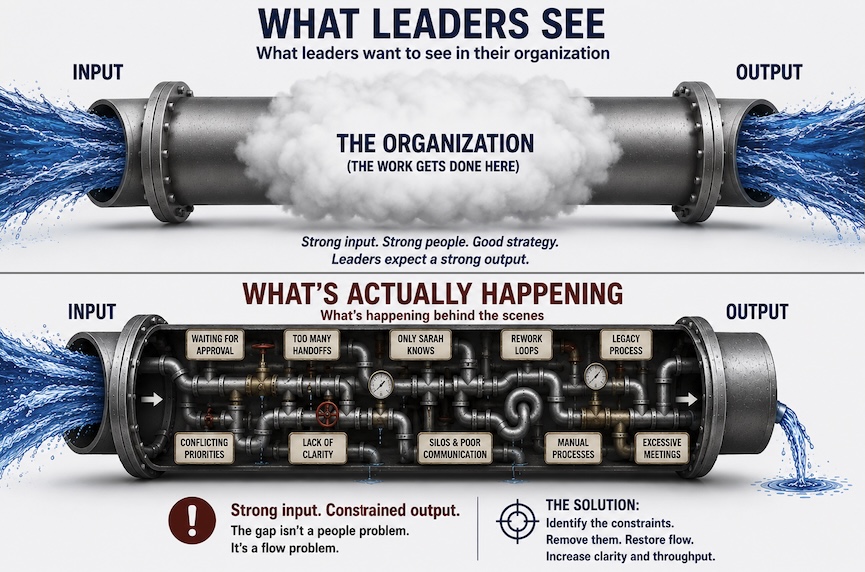
Imagine a six-inch pipe that is gradually reduced to four inches, then three, then two. Every restriction limits what can move through the system. The impact isn’t simply additive. Each new constraint compounds the effect of the ones already in place.
Organizations work the same way.
Leaders look at the people they’ve hired and the strategy they’ve developed and naturally expect strong results. What they can’t always see is everything that’s accumulated between input and output. The work is still moving, but every hidden constraint quietly reduces the organization’s capacity to execute.
That reality becomes even more important as organizations invest in AI and automation. Accelerating the input doesn’t automatically improve the output. If the system between the two is constrained, technology simply delivers more work to the same bottlenecks, faster.
The organizations that scale most effectively aren’t always the ones with the smartest people or the best strategy. They’re the ones that become disciplined about identifying and removing constraints before those constraints become accepted as “just the way we do things.”
The difficult part isn’t fixing constraints.
It’s seeing them.
Once leaders begin recognizing where work is waiting, looping, depending on a single person, or traveling farther through the organization than it should, they stop treating those issues as isolated frustrations and start seeing them for what they really are: signals that the system itself needs attention.
If your organization seems to be working harder without producing proportionately better results, I’d be glad to explore what hidden constraints may be standing in the way.