The Cost of the Workaround
Most workarounds begin with good intentions.
Something isn’t working the way it should, but the business still needs to move forward. A leader steps in. An extra approval gets added. A team creates a temporary process. Someone takes ownership of a problem that was never supposed to belong to them.
In the moment, those decisions are often exactly the right ones. They keep work moving, customers happy, and deadlines intact.
The problem isn’t the workaround itself.
The problem is that organizations rarely go back and remove it.
What was intended to be temporary often becomes part of the operating system. New employees are taught the workaround as if it’s the process. Teams begin coordinating around it. Leaders stop questioning it because it’s become so familiar that it no longer stands out.
That’s when the real cost begins to accumulate.
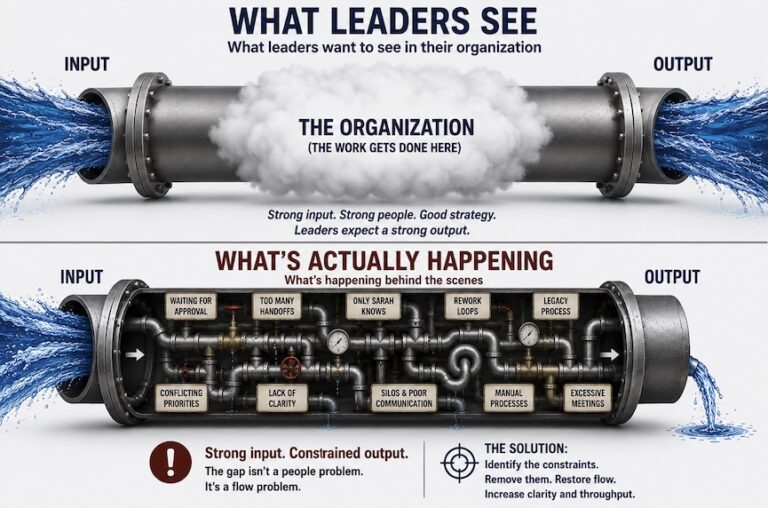
Every extra conversation. Every additional handoff. Every unnecessary approval. Every dependency on the same person. Every hour leaders spend solving problems that should have been solved somewhere else.
None of these costs appear all at once. They build gradually, while they silently absorb leadership capacity while the organization continues doing what it has always done.
From the outside, the business still looks healthy. Customers are being served. Revenue continues to grow. Yet beneath the surface, work feels heavier than it should, decisions take longer than they used to, and leaders find themselves pulled into issues they thought had already been delegated.
That’s why I encourage leadership teams to periodically ask a different question.
Instead of asking, “What’s broken?”
Ask, “What are we still working around?”
There’s a difference.
Broken things usually get attention.
Workarounds quietly become normal.
And once they’ve become normal, they begin shaping the organization in ways few people ever notice.
Some of the greatest opportunities for improvement aren’t found by creating new processes. They’re found by removing the temporary ones that were never meant to stay.
If this resonates, I’d be glad to explore what you’re seeing inside your organization. Sometimes the fastest way forward isn’t adding something new. It’s removing the workarounds that have quietly become part of the way work gets done.