Why Fixing Process Alone Won’t Fix the Problem
When something inside an organization isn’t working, the first instinct is usually to look at the process.
A workflow gets redesigned. Another approval is added. Someone documents a new procedure or introduces new software. The assumption is that if the process improves, the results will improve with it.
Sometimes that’s true.
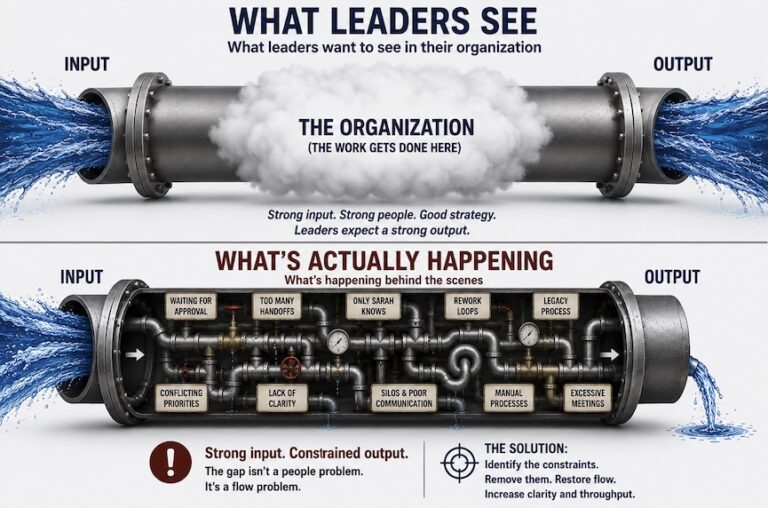
However, the process isn’t always the problem. It’s simply where the problem has become visible.
Over the years, I’ve found that many process issues are really symptoms of something deeper. Decision ownership has become unclear. A key employee has gradually become a bottleneck. Teams have developed workarounds that were meant to be temporary but slowly became permanent. Leaders have stepped in to compensate for gaps instead of addressing the conditions that created them.
None of those things show up on a process map, yet every one of them changes how work flows through the organization.
That’s why organizations can spend months refining a workflow only to find themselves dealing with the same frustrations six months later. The process changed, but the conditions that created the friction never did.
The real question isn’t whether the process is broken. It’s why the process evolved the way it did in the first place.
In many organizations, today’s processes are simply a record of yesterday’s compromises. Each adjustment made sense at the time. Each new approval, meeting, exception, or workaround solved an immediate problem. Over time, however, those reasonable decisions accumulate until they quietly redefine how the organization operates.
Eventually, leaders begin feeling the effects. Work takes longer than it should. Decisions move more slowly. Strong people spend more time compensating for the system than contributing through it. The organization continues producing results, but it does so with far more effort than necessary.
That’s why I rarely start by asking how to improve a process. I start by asking what the process is trying to compensate for.
Where has ownership become unclear?
What has become normal that no one questions anymore?
What conditions caused the organization to build this process in the first place?
Those conversations almost always uncover opportunities that another workflow diagram never could.
If you’ve been fixing the same operational problems over and over again, it may be time to stop looking at the process itself and start looking at the organizational conditions that created it.
I’d be glad to explore what you’re seeing inside your own organization.