What the Conchs Taught Me About Organizations
Several years ago, I was on a sailing trip in the Bahamas with my family. One afternoon, while windsurfing through a shallow bay, I came across something I had never seen before.
Five or six live queen conchs had been wired together and left on the ocean floor.
At first, I couldn’t make sense of it. They weren’t tangled by accident. Someone had intentionally connected them.
Later that day I asked one of the local fishermen what I had seen.
He smiled and said, “That’s how we keep them from moving around. Wire them together and they’ll stay put. Then we come back later and harvest them without a chase.”
I’ve thought about that conversation many times since, not because of the fishing, but because I keep seeing organizations that look exactly like those conchs.
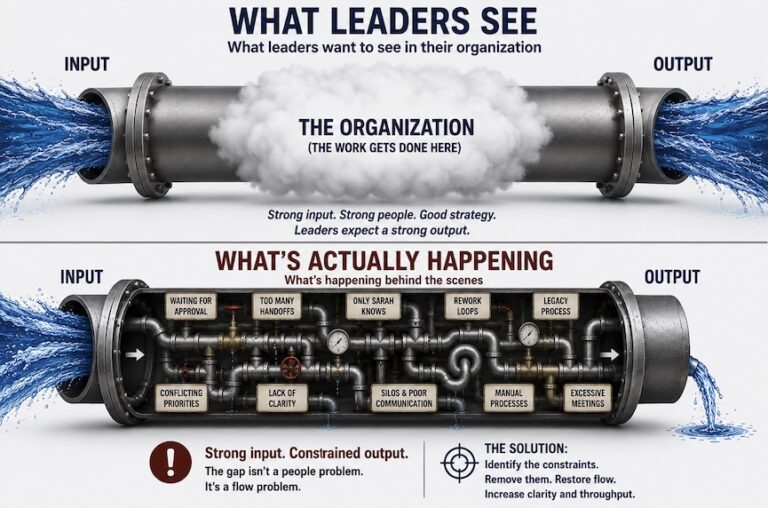
Most teams don’t stop moving because they lack talent or because people don’t care. Often it’s because they’ve become connected by invisible constraints that developed gradually over time.
A process starts waiting for one approval. A single person becomes the expert everyone depends on. Work begins flowing through informal channels instead of clear ones. Priorities compete for attention, and yesterday’s workaround silently becomes today’s standard (and restriction).
Individually, each decision seems reasonable. Collectively, they begin holding the organization in place.
That’s one of the reasons these constraints are so difficult to recognize. They don’t arrive all at once. They accumulate, slowly enough that people adapt to them instead of questioning them.
From the outside, the team appears busy. Everyone is working hard. Yet progress feels slower than it should, decisions take longer than they used to, and leaders begin wondering why growth suddenly feels so much heavier.
In my experience, that’s rarely a people problem.
It’s often a signal that something beneath the surface is connecting the organization in ways no one intended.
The conchs weren’t trapped because they lacked the ability to move. They were trapped because something invisible was holding them together.
I think about that every time I walk into an organization where capable people are working hard, yet progress feels more difficult than it should. And it seems like everyone is pulling hard, but pulling against each other.
Sometimes the most valuable question a leader can ask isn’t, “How do we get everyone moving faster?”
It’s, “What’s silently wiring us together?”
If this resonates, I’d be glad to explore what you’re seeing inside your organization. Sometimes the biggest breakthroughs don’t come from adding something new. They come from finally seeing what’s been there all along that’s holding you back.