Practical thinking for leaders navigating organizational complexity.
Observations drawn from real leadership practice.
-
Why Leadership Needs a System
As organizations grow, they naturally build systems for the things they know are important. Finance gets structure. Operations become standardized. Technology gets platforms and processes. Each area is designed to produce consistent results instead of relying on individual effort. Leadership is expected to scale without one. A high performer gets promoted into management. They do their…
-

What a 100-Year-Old Pair of Scissors Taught Me Yesterday
Yesterday I found myself using a pair of scissors that are more than a hundred years old. They belonged to my grandfather. My dad kept them for decades, and when he passed away, they ended up in a box with a handful of things I couldn’t imagine throwing away. I needed to trim a few…
-

The Cost of the Workaround
Most workarounds begin with good intentions. Something isn’t working the way it should, but the business still needs to move forward. A leader steps in. An extra approval gets added. A team creates a temporary process. Someone takes ownership of a problem that was never supposed to belong to them. In the moment, those decisions are…
-
Most Leadership Teams Are Running Below Capacity and Calling It Normal
When I spend time with leadership teams, one pattern shows up again and again. The issue usually isn’t a lack of capable people or committed leaders. In fact, most organizations are full of smart, hardworking individuals who genuinely want the business to succeed. The problem is that leadership capacity gradually gets absorbed by the organization itself.…
-
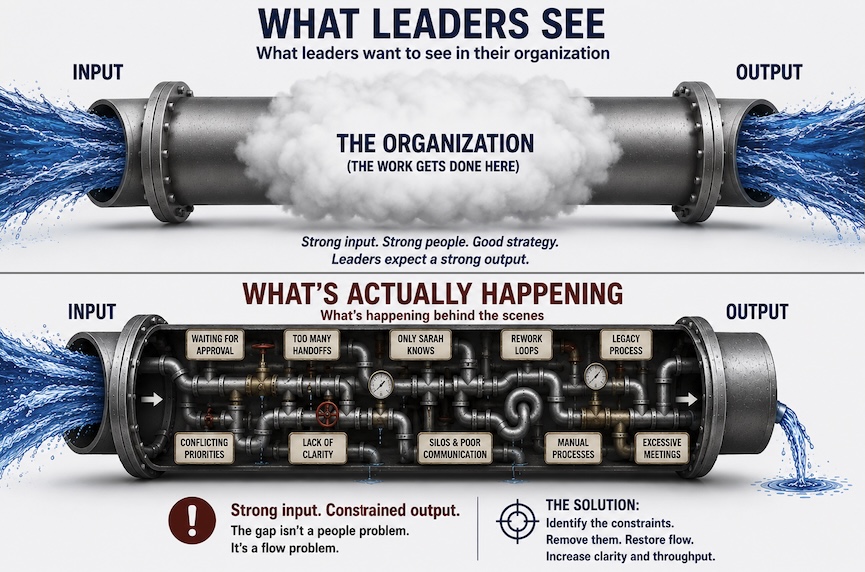
The Hidden Constraints Leaders Don’t See
Most organizations don’t struggle because they lack talented people. More often, they’re struggling because the flow of work has silently become constrained over time. It rarely happens because of one big decision. Instead, constraints accumulate one reasonable decision at a time. A decision begins waiting for another approval. A process becomes dependent on one person. A…
-

The Organization You’re Leading May No Longer Exist
That title probably sounds ridiculous. After all, you’re there every day. You know the people, you know how decisions get made, and you’ve watched the organization grow over time. So how could I possibly suggest that the organization you’re leading no longer exists? Here’s what I mean. One of the things I’ve noticed after spending…
-

A Leadership Cost Most Organizations Never Calculate
It’s capacity leakage. Teams rarely lose capacity all at once. Instead, it disappears gradually through small, almost invisible losses. Misalignment creates unnecessary rework. Simple decisions take longer than they should. Leaders compensate for gaps instead of addressing them, and decision ownership remains concentrated in the hands of a few people because they’re the only ones trusted…
-
Leadership Doesn’t Begin With a Promotion
Most organizations don’t set out to create weak leaders. In fact, they usually do exactly what seems logical. Someone consistently performs at a high level, earns the respect of their peers, and eventually gets promoted into a management role. It’s a reward for doing great work. The problem is that success in one role doesn’t…
-

What the Conchs Taught Me About Organizations
Several years ago, I was on a sailing trip in the Bahamas with my family. One afternoon, while windsurfing through a shallow bay, I came across something I had never seen before. Five or six live queen conchs had been wired together and left on the ocean floor. At first, I couldn’t make sense of it. They…
-

It Made Sense at the Time
If I had to summarize how most organizations become harder to lead, it would be in five words: It made sense at the time. Almost nothing that creates unnecessary drag inside an organization starts out as a bad idea. A customer needs an exception, so the team creates one. A leader steps in because it’s…
-

The Moment Growth Gets Expensive
As organizations grow, there comes a point where progress starts requiring noticeably more effort than it used to. Revenue may still be increasing, customers are still being served, and the business continues moving forward, but something feels different. Growth has become heavier. It rarely happens because of one major problem. Often it’s the result of small…
-
Why Fixing Process Alone Won’t Fix the Problem
When something inside an organization isn’t working, the first instinct is usually to look at the process. A workflow gets redesigned. Another approval is added. Someone documents a new procedure or introduces new software. The assumption is that if the process improves, the results will improve with it. Sometimes that’s true. However, the process isn’t always…