It Made Sense at the Time
If I had to summarize how most organizations become harder to lead, it would be in five words:
It made sense at the time.
Almost nothing that creates unnecessary drag inside an organization starts out as a bad idea.
A customer needs an exception, so the team creates one. A leader steps in because it’s faster than explaining the decision. An approval gets added to reduce risk. One person gradually becomes the expert everyone depends on. A new meeting is scheduled because communication has become difficult.
Individually, every one of those decisions is reasonable. In fact, most of them are probably the right decision in that moment.
The problem isn’t the individual decision.
It’s what happens after hundreds of those decisions begin interacting with one another.
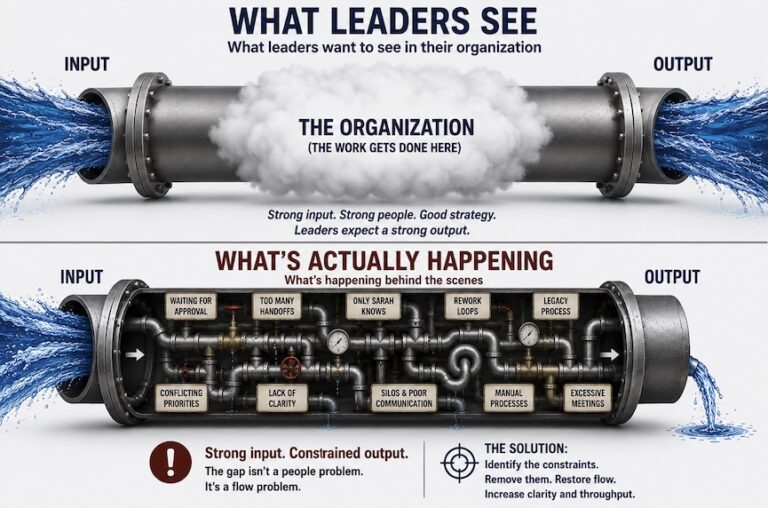
Over time, they create patterns that no one intentionally designed. Decisions start waiting for the same people. Work flows around bottlenecks instead of through the organization. Leaders become involved in things they thought they had delegated. Teams begin compensating for the system rather than benefiting from it.
The organization hasn’t become less capable. It’s become more constrained.
That’s why leadership often feels heavier than it should. The issue usually isn’t effort, talent, or commitment. It’s that today’s organization is operating within patterns that were created by yesterday’s solutions.
Those solutions solved real problems.
They simply outlived the problems they were designed to solve.
One of the most valuable questions a leadership team can ask isn’t, “What’s broken?”
It’s:
“What still exists simply because it made sense at the time?”
That’s a very different conversation.
It shifts the focus from fixing isolated problems to recognizing the patterns that have quietly formed beneath the surface. Once leaders can see those patterns, they can begin removing unnecessary constraints instead of continuing to manage around them.
Because organizations rarely become harder to lead overnight.
They become harder to lead one reasonable decision at a time.
If that idea resonates, I’d be glad to explore what you’re seeing inside your own organization.